“Kuchh zulm-o-sitam sahne ki aadat bhi hai hum ko/Kuchh ye hai ki darbar mein sunwai bhi kam hai”
The evocative Urdu couplet by Zia Zameer, offers a profound commentary on the endurance of the aggrieved in the face of an indifferent authority.
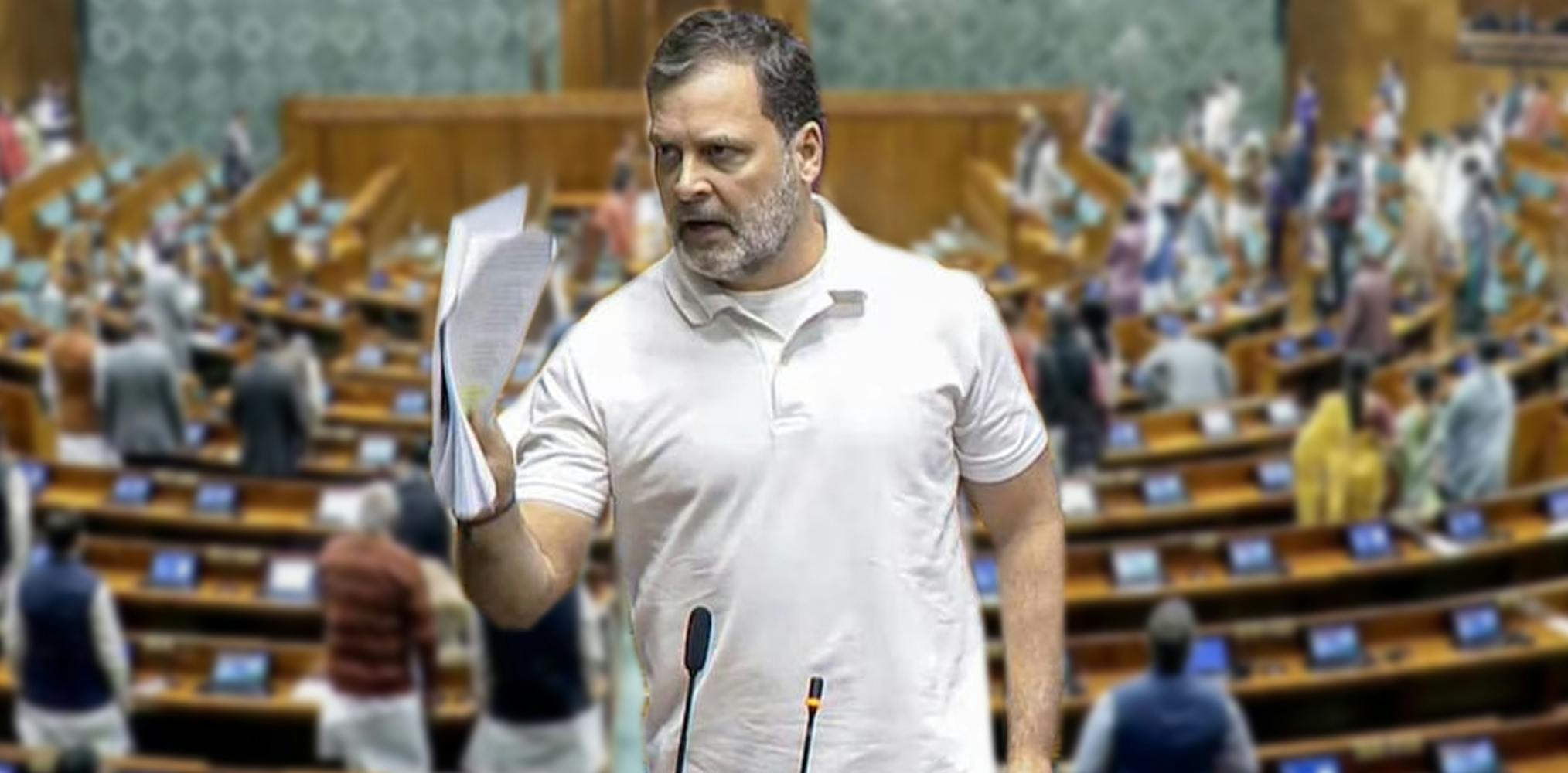
Translated as "I’ve learned to bear the weight of every wrong, for in the halls of power, my plea is never strong," this "victim’s lament" recently found a contemporary resonance within the Lok Sabha, wherein, the efforts of Rahul Gandhi, Leader of the Opposition (LoP), to secure a hearing amidst a phalanx of government objections, mirrored the weary defiance found in such classical poetry.
In what was ostensibly a confrontation over "what may and may not be quoted," the temple of democracy was transformed into a stage for the suppression of dissenting voices.
The friction originated when a member of the Treasury Bench questioned the Congress party’s patriotism and its understanding of Indian culture.
In his attempt to provide a clarification, the LoP sought to cite excerpts from “Four Stars of Destiny”, the unpublished memoir of former Army Chief General M.M. Naravane.
He argued that these excerpts would provide critical context regarding the 2020 India-China border crisis, effectively clarifying the "patriotism" of the parties involved.
However, this plea for a fair hearing was met with significant resistance. Three senior Union ministers intervened, citing Parliamentary Rules 349 and 353 to block the citation of unpublished and unauthenticated documents.
The Speaker upheld these objections, effectively dismantling the LoP’s chosen line of defence to prove the very patriotism of his party which was put under scrutiny by the member of the Treasury bench.
While the ruling party accused him of undermining the dignity of the House, he contended that the government was "scared" of the truth.
This incident underscores a troubling paradox in contemporary legislative debate. While the Treasury benches frequently utilise the floor to level broad, character-based allegations against the Opposition, procedural mechanisms are swiftly deployed as a "rod" to disqualify specific, counter-evidence.
When a Leader of the Opposition is barred from citing a text simply because the manuscript remains "languishing" in the limbo of government clearance, despite its contents already circulating in the public domain, the technicality ceases to be a procedural safeguard and becomes a gag order.
This procedural stonewalling breathes a bitter reality into the poetic lament of the Darbar(Royal Court): it confirms that in the halls of power, institutional gatekeeping is consistently used to shield the state from uncomfortable truths.
By weaponizing the rulebook to suppress evidence that has already reached the public square, the Treasury benches did more than just silence a speech, instead, they validated the LoP’s charge that the state is clinically afraid of its own record.
The result is a dangerous erosion of parliamentary equilibrium, where the Opposition is forced into a state of chronic endurance, navigating a system where the "hearing" is not just restricted, but systematically rigged to ensure the "Royal Court" never has to face a mirror.
Furthermore, the "clearance delay" regarding General Naravane’s memoir serves as a quintessential example of constructive censorship.
Unlike an outright ban, which invites public outcry, constructive censorship operates through administrative inertia and procedural technicalities. Because the book occupies a "grey zone", neither officially classified nor yet published, it allows the government to demand "authenticated documents" while simultaneously withholding the very seal of authentication required.
Ultimately, this shift signals that truth in the legislature is becoming a matter of permission rather than a matter of fact.
If the LoP is prohibited from speaking because the government has not yet "permitted" the source material to exist, the hearing is not merely restricted; it is pre-empted.
This ensures that the Opposition is left to "bear the weight of every wrong," as the Parliament risks transitioning from a robust hall of debate into a theatre of sanitised monologues where the "Royal Court" never has to face a mirror.
In the process, the LoP’s claim that the Treasury benches are "scared" of the excerpts is reinforced by the selective use of these rules. If the content were inaccurate, it could have been countered with facts, but by ensuring the content cannot be read at all, the government inadvertently confirmed that the "clearance delay" is a strategic shield, not a security necessity.
The whole gambit witnessed thereof transforms the parliament from a room of debate into a room of sanitized monologues, where opposition is left to bear the weight of every wrong, for in the halls of power its plea is never strong.