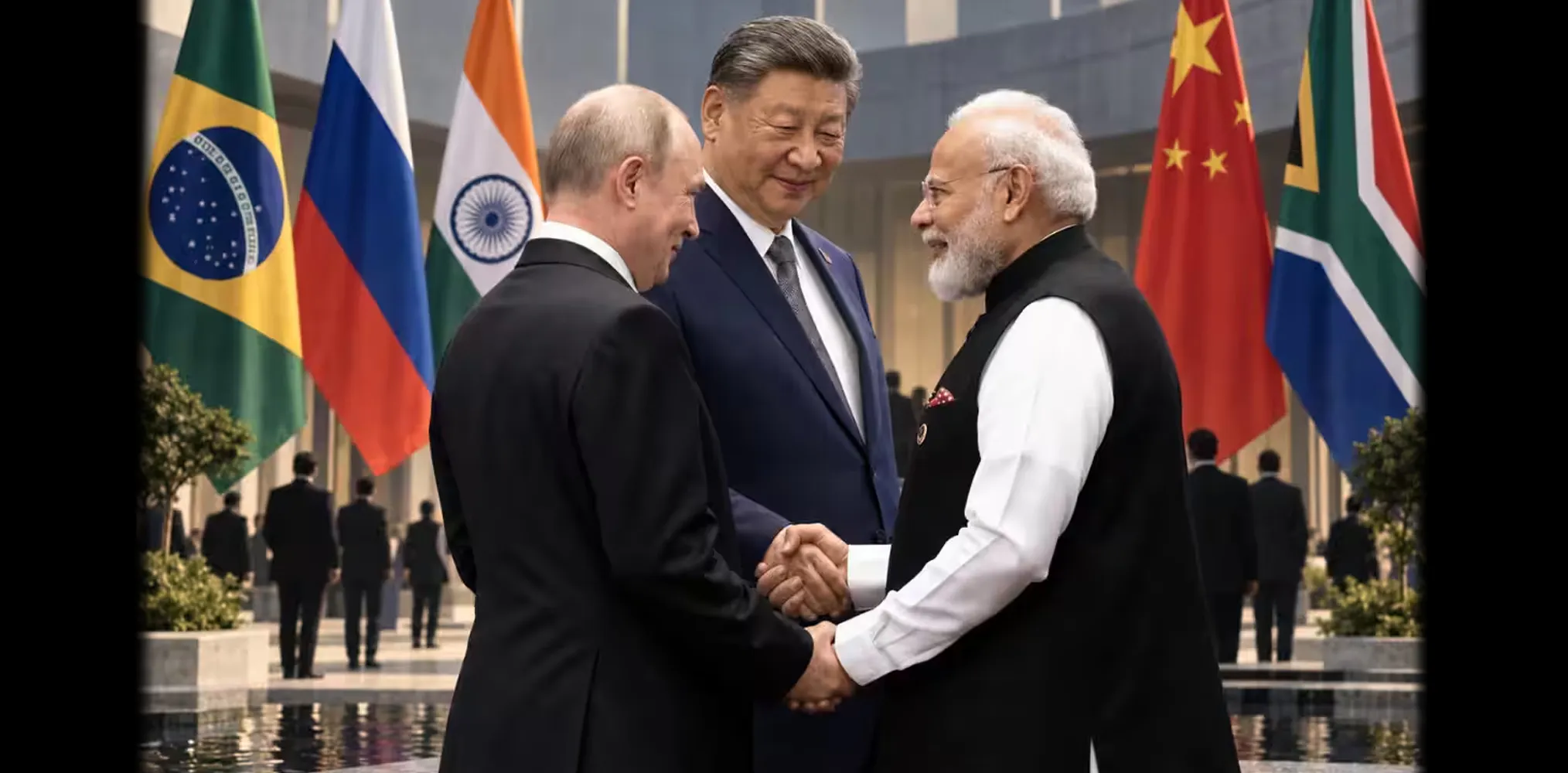
"Kahaani koi bhi ho, sach chhupaya ja sakta hai aur sach banaya bhi ja sakta hai. Zaroori yeh nahi ki sach kya hai, zaroori yeh hai ki log kya maante hain” (No matter what the story is, the truth can be hidden and the truth can be manufactured. What matters isn't what the truth actually is; what matters is what people choose to believe.)
This Bollywood movie dialogue is a perfect pop-culture adaptation of political philosophy on statecraft and manufactured consent, highlighting how political leaders immediately convert real-world emergencies into electoral currency. It reminds us that in the arena of political theater, a crisis is far too valuable an asset to be left to meander as one of those day-to-day happenings. It belongs instantly to the mythmakers.
Welcome to the grand theater of modern geopolitics, where actual facts are completely useless and the only thing that matters is who hires the loudest storyteller. Just like the master-manipulator Vijay Salgaonkar in the movie Drishyam 3, politicians in India, Israel, and the United States have realized that controlling the narrative is the ultimate power play.
The recent FlyDubai flight incident has officially ceased to be an ordinary aviation rescue story. Instead, it has been aggressively hijacked by global leaders desperately looking for their own blockbuster "Pulwama moment" to score cheap domestic political points. The political scriptwriters are working overtime, turning one pilot’s bravery into a massive international election campaign.
In India, the ruling BJP machinery has fast-tracked the incident into a personal victory for its Supreme Leader, loudly claiming the pilot's bravery is a direct byproduct of "strong national leadership."
The goal is simple: turn a real-life emergency into a hyper-patriotic frenzy to completely divert the attention from and crush the Opposition's planned October 2nd street protests.
Meanwhile, Tel Aviv's strategists are quickly framing the Middle Eastern aviation crisis as definitive proof of their hostile neighborhood, weaponizing the panic to justify aggressive military posturing and demand blind alignment from global allies. Not to be outdone, Washington politicians are instantly capitalizing on the chaos to claim strategic dominance in the region, feeding their domestic voter base a narrative of "American-brokered stability" to serve as potent fuel for their upcoming elections.
Naturally, the news channels are not just reporting the story, they are aggressively weaponizing it to serve the electoral interests of their political paymasters. Led by prime-time anchors who prioritize party affiliation over basic journalistic ethics, the heroic act of pilot Smit Machachar was instantly commodified into a partisan cudgel rather than being celebrated as a simple, brave rescue deserving of a Republic Day medal.
On the other side of the digital battlefield, the ruling party's social media warriors swiftly trapped the Opposition by demanding to know why Rahul Gandhi remained silent on the incident, using it to portray him as anti-national. The media effectively gaslit the public into framing all domestic daily grievances as irrelevant "cockroaches" compared to the pilot's flawless patriotism.
By branding the planned opposition street protests as total flops and anti-national conspiracies, this coordinated strategy perfectly mirrors the "Pulwama" formula. Just like the 2019 airstrikes successfully shifted the entire national conversation from pressing economic issues to national security, this aviation crisis is being used to build an impenetrable firewall of aggressive nationalism around the government.
This temptation of a "Pulwama moment", where a sudden security crisis is instantly converted into raw voter mobilization, seemed to offer an excellent lesson that was simply too lucrative for Washington and Tel Aviv to pass up. In Israel's playbook, politicians are painting the FlyDubai crisis with the aggressive brush of regional terror and existential threat, aiming to silence internal democratic dissent and tightly consolidate wartime power. On the American side, politicians view the incident as the perfect election-season photo-op to convince voters they are actively managing the Middle East, using the event to bully domestic opponents as "weak on global security."
Of course, it is a completely minor detail that a flight nosediving in a terrifying, vertical plunge somehow magically resulted in zero catastrophic injuries, an aviation miracle that apparently allowed a casual onboard plumber to meticulously study the physics of the descent mid-air.
In a twist totally unrelated to cinematic scripts, the coincidence also just happened to place off-duty pilots in civilian clothes right in the cabin, ready to step in at the exact climax for a picture-perfect landing.
It is almost as if the entire physics-defying incident was storyboarded in a Bollywood studio, custom-made for prime-time television rather than actual reality.
If the movie producers behind the recent blockbuster success of Drishyam are already planning a spiritual sequel titled Bhavandar, nobody should be surprised. The casting choices practically write themselves: Akshay Kumar would undoubtedly play the nationalist hero Machchar, Akshaye Khanna would bring intense gravitas to the Omani co-pilot, and John Abraham would flex his muscles as the physics-defying, mid-air-analyzing plumber.
Ultimately, while the brave pilot successfully saved the plane, the politicians managed to save their sinking approval ratings. In this real-world adaptation, the actual facts have been completely buried as the manufactured truth of political opportunists officially takes flight, ready to be turned into a box-office hit near you.